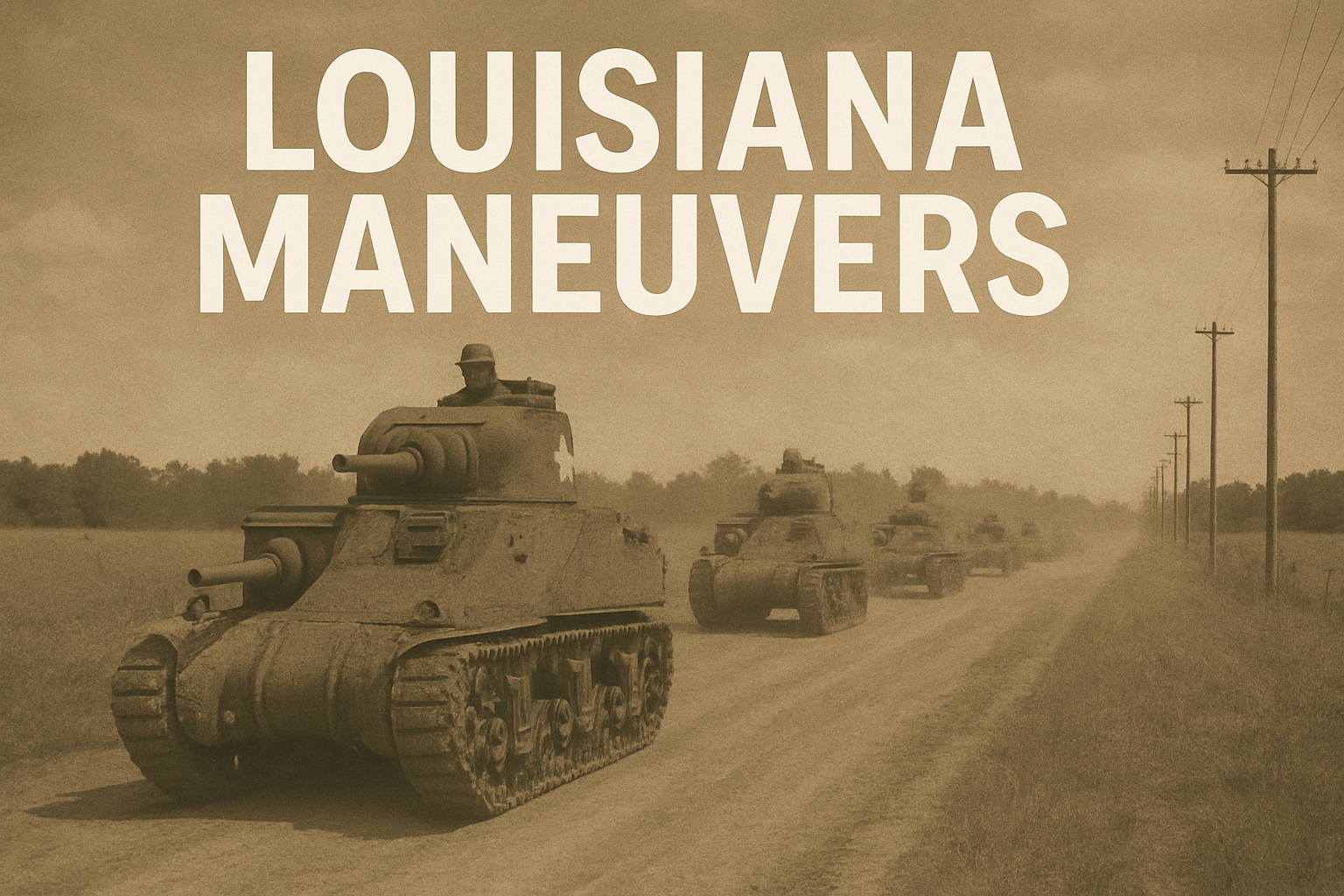
It was 1941, and the U.S. Army was preparing for war—though, technically, it wasn’t war just yet. With Nazi Germany dominating Europe and the doctrine of rapid, mechanized warfare proving devastatingly effective, the American military realized its existing infantry-focused forces were hopelessly obsolete. The Louisiana Maneuvers became the urgent response to this global threat, the largest peacetime military exercise in American history, involving hundreds of thousands of soldiers, thousands of vehicles, and tens of thousands of acres of muddy Louisiana and Texas wilderness. It was a grand experiment in warfare, designed to test out new tactics and technologies that would one day change the course of history. And in the thick of it all, standing at the center of the chaos, was a man who was as brash and unorthodox as the tactics he would utilize.
That man? General George S. Patton.

Patton was always on the move, always thinking about the next big thing. He didn’t wait for opportunity to knock; he charged at it headfirst, often equipped with his preferred Cuban cigars, and his revolver on his hip. The Louisiana Maneuvers were no different. They weren’t just a chance to test new technologies or simulate battles—they were Patton’s moment to showcase his vision of modern warfare. Tanks weren’t big, lumbering machines to him; they were the future.
A Grand Experiment: The Maneuvers Begin
The Louisiana Maneuvers weren’t some small-scale affair. They were an immense military exercise, designed to test the latest in U.S. military strategy and technology. In fact, they were the largest peacetime military exercise in American history up to that point. The U.S. Army had to figure out how to deal with the modern battlefield, where tanks and mechanized infantry would play an increasingly central role.
The maneuvers served a dual purpose: they were not just a training exercise but a public relations campaign. They were extensively covered by the press, providing a visible, massive demonstration of military preparedness at a time when the nation was incredibly divided over entering the war. This display helped justify the recently passed Selective Service Act (the draft) and convinced an isolationist public that a large, modernized army was necessary for national defense.
The setting was perfect. Louisiana’s swampy, muddy terrain would simulate some of the toughest conditions the U.S. might face in the coming war. It was all about testing mobility, tactics, equipment, and logistics. Would tanks get stuck in the muck? How quickly could they move across different kinds of terrain? Could they actually win a battle against a force of infantry? Would supply lines be able to keep up with the tanks’ insatiable appetite for fuel?
The maneuvers were split into two opposing forces: the “Blue Army” (Patton’s side), which was the more mobile force armed with the latest tanks, and the “Red Army”, led by a more traditional group of officers relying on slower, infantry-heavy tactics. Patton was determined to prove that tanks could dominate the battlefield.
The Surreal Rules of Engagement
Adding to the complexity was the utterly surreal system of umpires. With live fire prohibited, hundreds of neutral officers were scattered across the battlefield, armed with strict rule books and colored flags. It was their job to simulate the brutal reality of combat, determining whether a unit was “destroyed” or “disabled” based on how close mock munitions had landed.
This system was an organizational nightmare. Commanders like Patton, driven by tactical fervor, often openly ignored unfavorable rulings from the umpires to maintain the speed of their advance. This led to arguments, confusion, and a constant conflict between the desire to win the “game” and the need to follow the often arbitrary rules and decisions of the simulation. This breakdown demonstrated that in a real, fast-moving war, relying on human judgment to call hits would be impossible, further exposing the need for reliable, instant communication and clear command structures.
The Gathering of Future Giants
While the Louisiana Maneuvers are often synonymous with Patton, they were a proving ground for nearly all of the American leadership that would later win World War II. For example, Dwight D. Eisenhower, who was then a colonel, played a key, albeit less glamorous, role as Chief of Staff to the Red Army commander and later as an umpire. His experience seeing the massive logistical failures—the lack of communication, the breakdown of supply lines, and the difficulty coordinating a force of over 400,000 men—was every bit as important as Patton’s successful armored charge.

Eisenhower’s chief observation was that while the tanks were fast, the American military bureaucracy and logistics were hopelessly slow. This direct, large-scale experience provided him (and the Army) with the knowledge needed to reform the supply chain and communication systems, lessons that were directly applied when planning the invasion of North Africa and eventually D-Day. As a result of his performance in the maneuvers, Ike’s star began to rise and he was quickly promoted to Brigadier General. Omar Bradley, another future general, was also present, working on training and mobilization efforts, making the maneuvers a truly formative event for the entire American officer corps.
The significance of the maneuvers was recognized globally. In addition to the massive American press corps, foreign observers, including high-ranking military attachés from Great Britain and Canada, were present. They carefully analyzed the U.S. performance, assessing the capabilities of a potential future ally. The entire exercise was less a private drill and more a public, international display of American military intent.
The Boldest General on the Field
Patton was no stranger to controversy. He was known for his aggressive tactics, his quick decision-making, and—let’s be honest—his blunt personality. He wasn’t afraid to ruffle feathers, and that’s exactly what he did during the Louisiana Maneuvers. He wasn’t just playing a game; he was rewriting the rules of warfare. To prove the point, after an incredible 400 mile flanking run by Patton’s 2nd Armored Division, the Red army commander protested that Patton had taken his division outside of the legal maneuver area. Patton’s response: “I am unaware of the existence of any rules in war.”
One of his more famous moments came when the tanks, moving at full speed on the attack, ran out of fuel. There were no supply trucks to be found, and Patton wasn’t about to sit around waiting for logistics to catch up. So, what did he do? He drove his tanks straight to a gas station. Imagine it: a tank, engine rumbling, pulling up to a little gas station in rural Texas. The startled attendants, probably selling fuel to farmers and locals just minutes before, watched in disbelief as the tanks rolled in for a pit stop. This didn’t happen once. The 2nd Armored Division bought every gallon of gas at every rural station throughout east Texas. In the end, Patton got the fuel he needed, the tanks were back on the move, and the exercise-and Patton’s attack-continued.

This wasn’t just an amusing story—it was proof of Patton’s creativity and ability to think on his feet. Where others would have seen a logistical nightmare, he saw an opportunity to keep moving. It wasn’t the way things were supposed to be done, but it worked. And that’s the essence of Patton’s leadership style: never let obstacles stop you.
Logistical Chaos and the Real Lessons Learned
The Louisiana Landscape, full of forests, swamps, lakes, rivers, and creeks proved to be the ultimate testing ground. The goal was to test mobility, but the reality exposed a military structure that was still transitioning from a horse-drawn, infantry-focused force to a fully mechanized one.
The gas station stop highlighted an immediate need for fuel, but the maneuvers exposed deeper, systemic logistical deficiencies. The most critical failure, perhaps even more significant than the fuel crisis, was radio communication. In the deep swamps and forests of Louisiana, military radios proved unreliable, prone to failure, and often unable to communicate across the large distances required by armored warfare. Commanders often had to resort to using civilian telephone lines, or even sending runners and messengers, to relay critical battle orders. This failure to instantly communicate proved that the tactics of the German Blitzkrieg—rapid, coordinated movement—could not be replicated without a fundamental overhaul of Army signals technology.
Beyond tactics and leadership, the maneuvers delivered a harsh verdict on American hardware: the tanks used by Patton’s Blue Army, primarily the M3 Lee, were found to be too slow and under-gunned to face the rapidly advancing tank designs being used in Europe. The experience provided the urgent, non-negotiable proof necessary to justify a massive governmental investment. The lessons learned in the Louisiana mud directly accelerated the development of a superior medium tank, the M4 Sherman, which would become the workhorse of the Allied forces throughout World War II.
The maneuvers also tested the Army Air Corps, but this proved to be another area of critical failure. Pilots struggled to locate and communicate with friendly ground forces, often scouting positions only to find the tanks had moved miles away by the time the message was relayed. This poor air-ground coordination—a fundamental component of modern maneuver warfare—highlighted a significant doctrinal gap. The Army realized it needed dedicated tactical air units and specialized air-ground liaison teams to effectively integrate air support, a reform that would be vital to Allied dominance later in the war.
The report following the maneuvers mandated immediate, heavy investment in new, reliable radio and field telephone equipment, a change that rapidly modernized the American fighting force before Pearl Harbor.
The Ultimate Cost of Preparation
Finally, the maneuvers carried a costly reality: despite being a “game,” the size and complexity of the exercise led to tragic accidents. The combination of unfamiliar terrain, massive vehicle movements, and the inexperience of thousands of new draftees resulted in dozens of accidental deaths. Soldiers were killed in vehicle collisions, drowned in the swamps, sustained injuries in the field, or were victims of accidental weapons discharge. This unfortunate, sobering toll served as a wake-up call to military and political leaders that even the preparation for war was a deadly serious undertaking that demanded immediate, critical reform.

Furthermore, the scale of the operation caused immense disruption to local life. Tanks and vehicles damaged state and private roads, troop movements cut civilian telephone lines, and private property—especially fences and fields—was frequently damaged. The Army was forced to set up processes to swiftly settle claims and compensate Louisiana citizens for damages, providing valuable experience in managing the civilian component of a large-scale military operation.
Patton’s Legacy: From the Maneuvers to WWII
The Louisiana Maneuvers marked a critical pivot in U.S. military history. They allowed commanders like Patton, Eisenhower, and Bradley to test their ideas in real-world conditions, long before the stakes were as high as they soon would be in battle. And while the exercises didn’t have the same dramatic outcomes as actual combat, they shaped the future of the American war effort and modern warfare.
By the time the United States entered World War II, Patton’s aggressive tactics and his vision for armored warfare had already made a significant mark. The lessons of the Louisiana Maneuvers—particularly the emphasis on speed, communication reform, and reliable logistics—were incorporated into battle plans, and the mobility of tank warfare would become central to the U.S. Army’s success. Patton’s leadership, his unconventional methods, and his ability to adapt to changing circumstances would become legendary, both during the war and in the years that followed.

And let’s not forget the gas stations. The story of Patton’s fuel stop in Louisiana is now a classic anecdote—an example of his unorthodox methods and his ability to get things done, no matter the odds.
The Beginning of a Legend
The Louisiana Maneuvers were a turning point in U.S. military history. They were the proving ground for strategies, technologies, structures, and leaders who would go on to change the course of World War II. And at the heart of it all was General George S. Patton—a man who was as much a showman as he was a military genius. Whether he was charging through swamps in tanks, yelling at his men to move faster, or finding new ways to fuel his machines, Patton represented the spirit of these maneuvers: aggressive, unrelenting and mission-focused, and always forward-moving.
So, the next time you hear a story about General Patton, think about the Louisiana swamps, the sounds of tanks in the distance, and the unshakable confidence of a man who knew that if you wanted to win, you had to keep moving—no matter what.







Leave a Reply