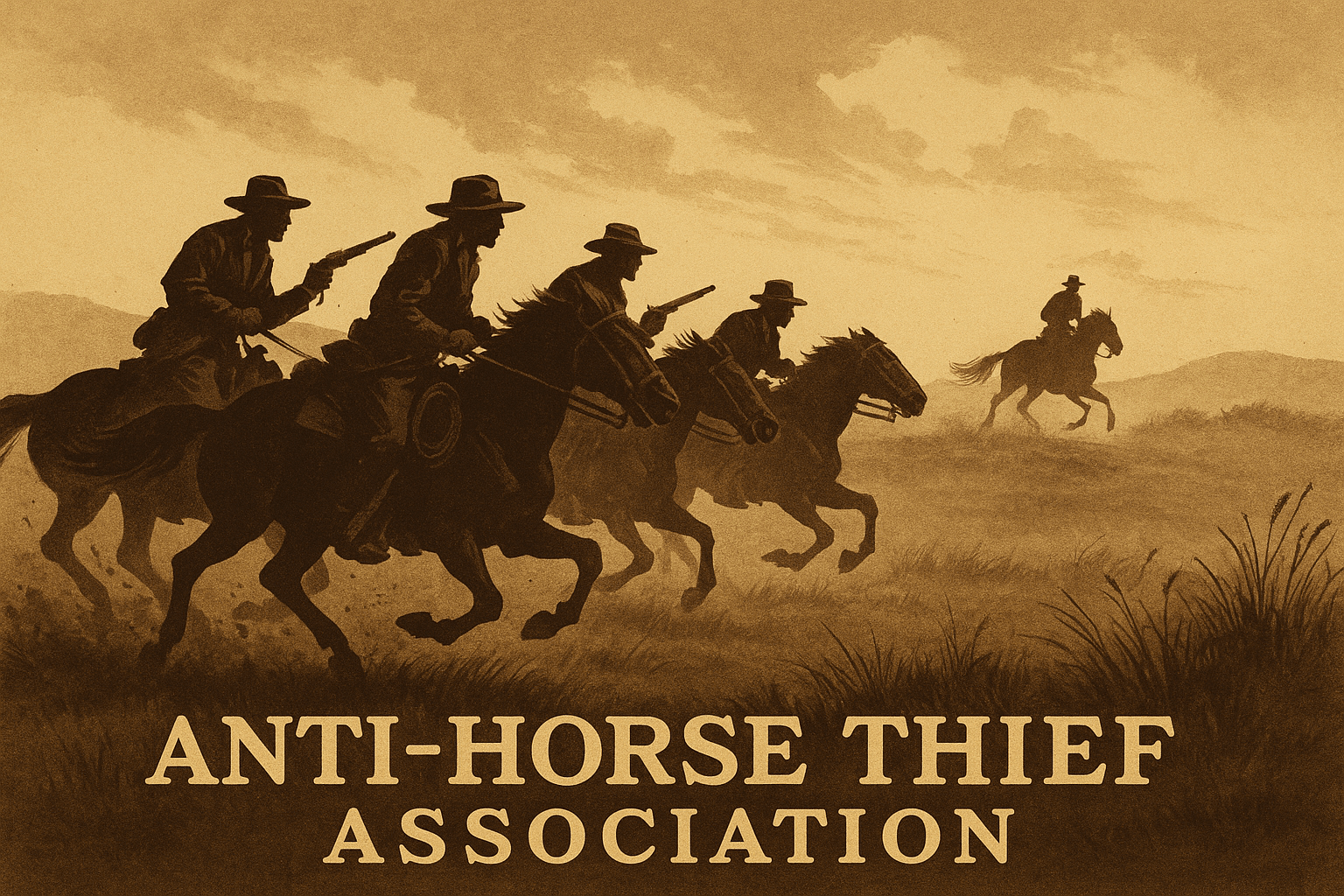
Long before sheriffs and marshals spread across the frontier, horse theft was the crisis that kept communities up at night.
A man’s mount was his livelihood and his protection. Losing one was a catastrophe. Vast stretches of open territory and almost no organized law enforcement left farmers and settlers exposed; and the thieves who preyed on them knew it. Something had to be done, and eventually, somebody did something.
The Economic and Societal Impact of Horse Theft
To understand why the AHTA caught on the way it did, start with the horse.
It was a working tool and a financial instrument. A quality saddle horse sold for $150 to $200 at a time when a farm laborer made fifty cents a day. Do that math. One stolen animal erased a year’s wages.
The horse was the agricultural engine; it plowed the fields and powered the machinery. Without it, planting was delayed and harvests spoiled. It was also the only reliable way to cover the distances of frontier life, connecting isolated settlements to the wider world.
In remote areas, livestock served as loan collateral and a rough substitute for currency. Lose your horse and your farm, your income, and your family’s security went with it. This is why frontier justice treated horse theft with a severity that can seem extreme from a modern vantage point. The stakes were that high.
The frontier was the horse thief’s greatest ally. Vast, sparsely settled territory gave a thief running room no local sheriff could match. Cross a state line within 48 hours and you were functionally untouchable, well beyond any single jurisdiction’s reach.
Branding registries were unreliable and the telegraph hadn’t reached most of the backcountry. A farmer in Missouri had no way to warn anyone in Texas. Thieves ran in loose syndicates, moving stolen animals along established routes locals called “Thieves’ Trails” (sometimes “Underground Roads”), a chain of relay stations spaced just far enough apart to stay ahead of pursuit.
The stolen stock moved fast and far. Stopping it required an equally organized, cross-county response.
So in 1854, a group of farmers and concerned citizens in Clark County, Missouri, decided to build one. They called it the Anti-Horse Thief Association; there was no doubt about its purpose.

The Mechanism of the Chase: AHTA in Action
What set the AHTA apart from other frontier vigilante efforts was discipline. Most such groups trended toward lynch mobs and extrajudicial violence. The AHTA ran on rules.
Members took oaths and paid dues. They elected officers and maintained formal membership rolls. They issued documentation on suspected thieves and tracked rewards for information. It had more in common with a private detective agency than a posse, which is more or less what it was.
The engine behind its effectiveness was communication. The AHTA was, in practical terms, the first decentralized inter-state law enforcement body dedicated to a single class of crime. When a member’s horse went missing, a sequence kicked in immediately.
The victim notified the chapter’s elected Captain, who convened available members, assessed the probable escape route, and began pushing information outward. A standardized report went out; a physical description of the animal and whatever was known about the thief, carried by mounted riders to neighboring chapters.
As the organization grew, telegraph offices became the nervous system of the operation, pushing coded messages hundreds of miles in minutes. Later, members tapped into early rural telephone lines to move faster than any official agency could manage.
The pursuing posse also had a legal advantage most lawmen lacked: the willingness to cross jurisdictional lines. A posse was often accompanied by a sheriff or justice of the peace who could deputize members on the spot, giving them standing to pursue across county lines under hot pursuit, or by pulling warrants from officials in the next jurisdiction upon arrival.
The chase was a relay. A thief, once spotted, was rarely run down by the same men the whole way. As one posse tired, it handed the pursuit, and everything it knew, to a fresh chapter waiting down the trail.
Thieves frequently abandoned stolen animals well before reaching their destination, simply because the pressure never let up. The AHTA’s own records put animal recovery rates above 80%. For a grassroots organization with no government backing, that number is remarkable.
The Rituals and Secrecy
The AHTA transplanted the entire fraternal organizational model onto the frontier. This wasn’t decoration. It was social engineering.
The mid-to-late 19th century was a golden age of American fraternal societies; the Masons, the Odd Fellows. These organizations understood something the AHTA’s founders grasped immediately: ritual creates belonging and loyalty, and loyalty creates discipline.
A man who has taken an oath in front of his neighbors and sung a hymn alongside them is considerably more reliable than a man who just signed his name to a list.
The initiation ceremony followed an exact script. A candidate was introduced to the Vice President, who confirmed his motives were pure and his willingness to obey the rules of the order was genuine. He then placed his right hand on his left breast and swore an oath.
He promised to keep the passwords and secret signs undisclosed. He promised to protect fellow members’ families and property from theft and to render all possible assistance in capturing and prosecuting lawbreakers.
As he was conducted to the President’s station, the assembled members sang the Initiation Ode, set to the tune of “He’s Just a Volunteer”, welcoming the new Brother Anti into the fold. The whole thing reads today like something between a Masonic lodge and a frontier courtroom proceeding. Which, functionally, is what it was.
Meetings ran like a formal operation. The President opened with a gavel. The door was sealed. The Marshal made his rounds, collecting the password from every man present.
Anyone who couldn’t produce it was asked to leave; or, in the case of a visitor from another chapter, vouched for by name before being permitted to stay. When the “secret work” was to be taken up, even visitors without the current password stepped outside. The AHTA took operational security seriously.
Members were issued a system of private signs and grips; physical gestures that could identify a fellow Anti in unfamiliar territory without a word exchanged. The horses themselves were marked: bridle rosettes advertised AHTA membership, signaling to the community — and to thieves — that this animal was under the organization’s protection.
Badges and ribbons were worn at public events. Insignia and fobs circulated as membership tokens, eventually becoming collectibles still turning up in attics and estate sales today.
The secrecy served two purposes that reinforced each other. First, it protected members from retaliation. The AHTA was dealing with organized criminal networks, and a man whose name appeared on a membership roll had reason to be careful. Keeping meetings private and identities guarded allowed members to discuss active cases without tipping off suspects.
Second, the secrecy was a deterrent in its own right. A horse thief moving through AHTA territory had no way of knowing who was a member. The farmer he passed on the road, the shopkeeper in the next town; either of them could be a networked, oath-bound Anti with a relay of riders already in motion. That uncertainty made theft considerably riskier than it looked.
The chapter governance — elected Presidents, Secretaries, Treasurers, Marshals, and Guards — mirrored the structure of established fraternal orders, lending the AHTA a stability that improvised vigilante groups couldn’t sustain.
Chapters maintained dues records and regular correspondence. They kept minutes. This was the infrastructure that made the pursuit relay possible; you can’t hand off a chase to the next chapter if the next chapter isn’t organized, funded, supplied, and ready to ride.

Expansion and the Civil War
The Association’s reach expanded quickly. Within two decades of its founding, chapters had spread from Missouri and Kansas into Oklahoma and Illinois, then further still.
Indian Territory, outside the jurisdiction of surrounding states, had become a natural haven for thieves, and the AHTA’s reach followed them there. In towns where lawmen were few and jails practically nonexistent, the organization filled the void.
Some chapters worked alongside local sheriffs. Others became the de facto law in their communities. By the 1880s, membership was in the tens of thousands. Even farmers and ranchers with no immediate need for protection joined up; partly out of civic spirit, partly because in an AHTA town, a man who hadn’t joined invited a certain amount of suspicion.
Then the Civil War arrived, and it complicated everything.
Missouri and Kansas were already the bloodiest theater of the pre-war sectional conflict; the border raids, the running battles between pro-slavery “Border Ruffians” and antislavery “Jayhawkers” that had been escalating since the mid-1850s. When the national war began, it didn’t replace this guerrilla conflict so much as absorb it.
Quantrill’s Raiders and other Confederate bushwhacker units operated throughout the Missouri-Kansas border, burning farms and living off stolen horses. Their counterparts on the Union side, the jayhawkers and Kansas “Red Legs”, were no better. Both sides needed horses and both sides took them where they found them.
For the AHTA, this created a genuinely dangerous situation. Horse theft was no longer just a crime; it was a political act, a military act, a survival act, depending on who was doing it and why.
An accusation of horse theft could easily become an accusation of disloyalty. Some members sided openly with Union forces and used the organization’s networks to identify Confederate sympathizers.
Others operated in the gray spaces between armies, rendering their own justice in stretches of backcountry too lawless for either side to govern.
It’s worth noting that the chaos of the border war may have actually accelerated the AHTA’s formal organization rather than disrupted it; historical records point to a key organizing meeting at Luray, Missouri, in September 1863, in the middle of the war, as the moment the network began to take on its mature national structure.
After the war, the AHTA refocused and grew faster than it ever had. The conflict had left the border states flooded with displaced men and stripped of whatever thin institutional infrastructure had existed before. The need for the AHTA’s model was more acute, not less.
Chapters spread into Arkansas and Colorado. Courts began formally recognizing the organization’s value. One contemporary account described its approach: the AHTA “uses only strictly honorable, legal methods” and “does its work so systematically and efficiently that few criminals can escape when it takes the trail.”
By 1916, membership stood at over 40,000 across nine states. The AHTA’s horseshoe emblem could be found in all manner of ways, from Missouri to South Dakota.
Times were changing, though. The railroad knit the frontier together and made distant lawmen reachable. The telegraph put a sheriff’s description in a dozen towns before a thief could clear the county line.
State and local law enforcement gradually professionalized. The conditions that had made the AHTA necessary were being dismantled, one by one, by technology and governance.
The organization adapted. Annual meetings replaced field reports. Picnics and roping competitions replaced manhunts. A Ladies’ Auxiliary organized social events and charitable work. The AHTA was becoming less a posse and more a civic club, which, given what a posse’s average Tuesday looked like, was probably an improvement for everyone involved.

The 20th century was not kind to the AHTA, and not only for the obvious reasons.
World War I pulled men out of rural communities and never fully returned them. Membership dropped and chapters went dormant.
The automobile was finishing what the railroad had started. Horses were becoming livestock rather than transportation, and stealing one was drifting from felony toward misdemeanor in both law and public perception. The AHTA tried to evolve.
An Arkansas state convention in 1916 voted to de-emphasize horse theft investigations in favor of the moral education of the young. An organization founded by men who rode through the night after armed criminals was now debating youth character programs. The frontier had closed and taken the AHTA’s reason for existing along with it.
There was a darker complication too. As the organization’s original purpose faded, it became vulnerable to the same forces reshaping rural America in the 1920s.
Infiltration by the Ku Klux Klan was documented as a specific factor in the AHTA’s decline; the Klan recognized that fraternal organizations with broad rural networks and quasi-legal authority were useful infrastructure, and it wasn’t shy about moving in.
The AHTA that had built its identity on lawful, disciplined pursuit wanted nothing to do with that, but the damage to membership and reputation was real.
By 1926, the national organization had renamed itself the Anti-Thief Association, dropping the horse entirely. It didn’t help.
The Great Depression finished what World War I had started, and membership collapsed. Some chapters dissolved. Others hung on as social clubs, holding annual picnics and roping competitions under a banner that had once meant something considerably more urgent.
A few technically still exist today – in Bentonville, Ohio; Nepeuskun, Wisconsin; and Arenzville, Illinois — holding social functions and contributing to local causes. Lifetime membership in the Bentonville chapter runs one dollar.
What’s left of the AHTA beyond those handful of survivors lives in attics and county archives.
Record books contain the names of men who rode out in the dark after armed thieves. Badges and fobs turn up in estate sales, handed down from grandfathers who remembered when their town had no sheriff worth mentioning, but had the AHTA.
The ritual books survive. So do the chapter minutes, the standardized pursuit reports, the membership rolls.
The AHTA was a product of necessity. When the government couldn’t reach a problem, a group of farmers in Clark County, Missouri, built their own solution; oath-bound, organized, and disciplined enough to operate across state lines before the telegraph could keep up.
It worked. Not perfectly, and not without the moral ambiguities that come with any organization operating made up of people, and where law hasn’t arrived yet. But it worked.
That’s the story; not a romance about the frontier, but a straightforward account of what people do when they’re left on their own and the stakes are high enough to demand something better than nothing.







Leave a Reply