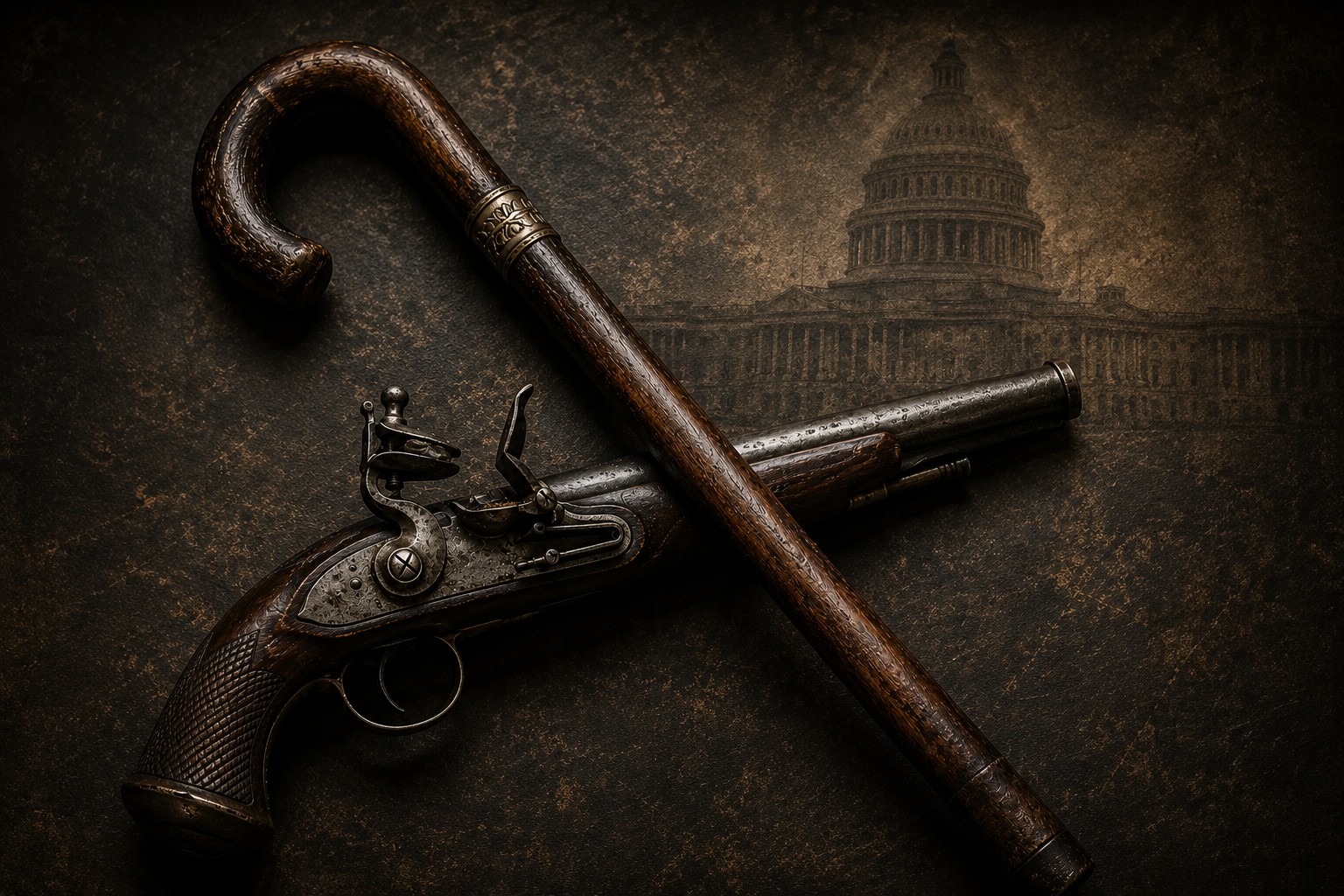
Washington woke up to a wet morning on January 30, 1835.
Representative Warren Davis of South Carolina had died four days earlier. The House scheduled his memorial inside its chamber at the Capitol, and funerals for sitting congressmen were still rare enough in 1835 to draw a full house.
This one drew an unusually mixed crowd. Men who spent every other day of the session shouting at each other sat together that morning. Even Washington’s bitterest rivals could manage a truce for a funeral.
President Andrew Jackson came too. It was expected of him.
He was sixty-seven, and he looked it. He walked with a stoop. He leaned on a cane because he needed it, not for effect. A British writer touring the country that year, Harriet Martineau, described him as tall and thin, with a weakness that seemed to belong to a much older man.
He was still carrying a bullet in his chest from a duel thirty years earlier; one souvenir among several from a life that had never once backed down from a fight. Nothing about how he looked that morning would have told you that.
Waiting near the Capitol’s east portico that morning was a man named Richard Lawrence. Unemployed house painter. Two pistols under his coat. He had been watching Jackson for weeks and told people he intended to kill him.
Nobody who mattered took him seriously enough to do anything about it. That’s its own kind of quirk, though not the one this story is really about.
The funeral ended. The crowd filed out through the Rotunda toward the east door, Jackson working his way through it toward his carriage. Lawrence stepped out from behind a pillar, closed to a few feet, drew a small percussion pistol, aimed at Jackson’s chest, and fired.
The cap went off. The charge didn’t. A crack of noise, a puff of smoke, and nothing.
Jackson didn’t run. He raised his cane and went straight at the man who had just tried to kill him; by most accounts already swinging before Lawrence could recover enough to draw the second pistol. Same make. Same load. Same priming.
Lawrence fired again, point-blank, at a sitting president who had closed to arm’s length.
It also failed.
Bystanders swarmed him before he could try a third time, not that he had a third gun. Congressman Davy Crockett and Navy Lieutenant Thomas Gedney pinned him to the ground while Jackson’s aides hustled the president toward his carriage; furious, unhurt, and already certain, completely and immovably certain, that what had just happened to him was not one sad man acting alone.
He was wrong about that. It would take the United States Senate the better part of a month to prove it. Even then, Jackson never fully let it go.
Decades later, the Smithsonian test-fired pistols of the same type and design. Every one worked, every time. A firearms expert who studied the case put the odds of both of Lawrence’s guns failing back to back at something like 125,000 to 1.
Jackson had just become the first sitting American president to survive an assassination attempt, saved by damp powder and a run of luck absurd enough that some of his supporters called it Providence.
Jackson thought it was something else. He called it an enemy.

The Painter
Richard Lawrence was born in England, sometime around 1800, and crossed the Atlantic with his family at twelve. They settled in Virginia, close enough to Washington to make the city part of the family’s orbit.
By most versions of the story, he grew up unremarkable in exactly the way that matters here. Acquaintances later described him as reserved and industrious; the kind of young man nobody bothers to write anything down about, because there’s nothing worth writing. At least not yet.
He became a house painter. Steady trade, honest work, a job that puts you inside other people’s homes and gives you no particular reason to expect anything from the men who run the country.
For most of his adult life, that was the whole story. Then, around 1833, something changed.
His two brothers-in-law would later testify to the change under oath, and their account was consistent: within eighteen months, Lawrence went from relatively normal to a man who muttered to himself in his own paint shop about the President of the United States.
The delusions, once they arrived, arrived fully formed. He believed he was Richard III, King of England, dead since 1485 and somehow not finished with his reign. He believed the American colonies owed him money as a result of that claim.
He believed Andrew Jackson was the man standing between him and that money; specifically because Jackson opposed rechartering the Second Bank of the United States, an institution Lawrence had apparently decided was his to control.
He also believed, on a separate and unrelated track that ran alongside the first without ever quite reconciling with it, that Jackson had killed his father.
Neither claim bore any relationship to fact, of course. Lawrence’s father was alive. Jackson had never met him. None of that mattered to the plot Lawrence had built inside his own head, which didn’t require external confirmation to keep going.
Neighbors noticed. Witnesses would later testify that Lawrence had taken to sitting in his shop for long stretches, doing nothing, talking to nobody in particular. On the morning of January 30, 1835, one of them saw him sitting there with a book in his hand, laughing.
Then he got up, put the book down, and said out loud to no one: “I’ll be damned if I don’t do it.”
He left the shop. He had two pistols. He knew where the President of the United States would be standing in a few hours, because Jackson’s schedule that day was public knowledge, and Lawrence had been paying closer attention to it than anyone around him realized.
None of what happened required a conspiracy. It required one man, a disease induced set of beliefs, and a country that hadn’t built any mechanism for noticing him before he acted on them.
Andrew Jackson wasn’t going to see it that way. He never really could.

Old Hickory’s Enemies List
Jackson didn’t wait for evidence. He barely waited for the carriage ride home.
Within hours of the attempted shooting, he had already settled on an explanation, and the explanation wasn’t Richard Lawrence. To Jackson, Lawrence was a tool. Somebody else had pointed him.
The first name that came up was John C. Calhoun; former vice president, former ally, now the leading voice of everything Jackson had spent his presidency fighting.
Days before the shooting, Calhoun had stood on the Senate floor and said Jackson was a Caesar who ought to have a Brutus. It was a line a man says for effect and regrets when someone takes it literally.
Calhoun took the floor again after the shooting, this time to swear he’d had nothing to do with it. Jackson never fully believed him. But Calhoun wasn’t where Jackson’s suspicion ultimately landed.
That distinction went to George Poindexter, senator from Mississippi.
The two men went back decades, and not as enemies. They’d fought together at the Battle of New Orleans. Poindexter had defended Jackson through two of the ugliest scandals of his career, the unauthorized invasion of Spanish Florida, and the execution of two British subjects captured there; testimony that arguably saved Jackson’s career both times.
They were also remarkably similar men. Proud. Quick to take offense. Fond of dueling as a method of settling disputes that other men would have let go.
Which is presumably part of why the friendship didn’t survive the Bank War. Poindexter broke with Jackson over money and patronage, the two things that end more political friendships than ideology ever does, and the break didn’t stay professional.
Poindexter accused Jackson of corruption in public. Jackson slandered him right back.
By January 1835, Poindexter was, in Jackson’s private ranking of people who wanted him dead, at the top of the list.
He told everyone who came to see him at the White House that afternoon. Poindexter had done this. Poindexter had put Lawrence up to it. He didn’t have proof. He had certainty, which in Jackson’s mind had always functioned as a reasonable substitute.
Word reached Poindexter fast, and he did the only thing a man in his position could do: he demanded the Senate investigate him formally, in public, under oath; the surest way to either clear his name or end his career, and he apparently preferred the risk to the alternative of letting the accusation sit unanswered.
He got his investigation. Whether it would clear him was a separate question, and not one Jackson seemed especially interested in waiting to find out.

The Senate Investigates Itself
Vice President Martin Van Buren got the job nobody wanted: chairing a Senate committee tasked with investigating whether the sitting president, his boss, had baselessly accused a senator of conspiracy to commit murder.
He started, reasonably enough, by questioning Jackson himself.
Jackson didn’t hedge. He told the committee he could produce fifty witnesses linking Poindexter to Lawrence. Fifty. It was a number someone throws out when he’s certain he’s right and hasn’t had to prove it.
Fifty witnesses did not materialize. Two did.
Mordecai Foy was a blacksmith who did occasional work for the White House. David Stewart claimed, among other things, that Poindexter owed him money. Between them, they signed affidavits swearing they’d seen Richard Lawrence visit Poindexter’s house in the days before the shooting.
It should have been damning. It fell apart within minutes of cross-examination.
Foy didn’t know where Poindexter lived. Stewart couldn’t describe what Lawrence looked like; a curious gap in the memory of a man claiming to have watched him walk into a house.
People who knew the two men testified, without much diplomacy, that Foy drank heavily and Stewart lied habitually.
It got worse from there. Foy eventually admitted that a government contractor named Charles Coltman had promised him work on an iron fence at the Treasury Department if he’d finger Poindexter. The affidavit hadn’t been testimony; it had been a job application.
By early March, the committee’s report was unanimous, and it wasn’t kind to anyone involved. Poindexter was cleared. Foy was dismissed as a drunk. The committee expressed its hope that Foy and Stewart would be, in the language of the day, held up to public odium.
Here is where the story has a twist that’s more than just exonerating an innocent man.
Poindexter’s name was cleared. His career was not saved.
The public anger that had briefly attached itself to him, stoked by a president who’d told the White House press corps he had fifty witnesses, didn’t evaporate once the investigation ended. It redirected, but only partly, back onto Jackson for making the accusation in the first place.
Some of it stuck to Poindexter regardless, the way suspicion tends to do despite a lack of proof. He lost his reelection bid and went home to Mississippi, done in national politics.
Jackson, meanwhile, absorbed almost none of the damage. He had a year left in office and nothing left to lose by being disliked. The backlash cost him some goodwill he’d earned by surviving a point-blank assassination attempt, and he spent that goodwill fast, but it never touched his actual position.
The institution designed to establish the truth did exactly what it was supposed to do. It found the truth. It cleared the innocent man. And the innocent man’s career ended anyway, while the man who’d wrongly accused him walked away from the whole episode largely unscathed.
That’s not a failure of the process. The process worked. It’s an example of how being formally exonerated and being made whole are two different things, and the country’s institutions have only ever promised the former.

The Trial
The trial opened April 11, 1835, at the District of Columbia City Hall ten weeks after the shooting. Lawrence had spent the interval in custody, and nothing about that time had made him more cooperative.
His attorneys tried something unusual before the trial even started: a motion to keep their own client out of the courtroom.
Lawrence, left to speak for himself, was often composed and defiant rather than raving; the kind of performance that could read to a jury as contempt, not madness. His lawyers wanted the case argued by witnesses and doctors, not narrated live by a man who might tell the jury, to their faces, that they answered to him.
Judge William Cranch denied it. No precedent for excusing a defendant from his own criminal trial, however inconvenient his presence might be for the people arguing he wasn’t responsible for his actions. Lawrence stayed.
Prosecuting for the government was Francis Scott Key; already a well-known Washington attorney by 1835, and not yet the man the country would eventually remember chiefly for a poem he wrote off the coast of Baltimore twenty years earlier. In 1835 he was simply the district attorney, doing the job.
Key’s argument was narrower than it might have been. He didn’t dispute Lawrence’s underlying mental instability. He argued instead that Lawrence had shown too much of what the law called design; buying two pistols, tracking Jackson’s schedule, waiting behind a specific pillar at a particular time, to qualify as a man who didn’t understand what he was doing.
Premeditation, in Key’s framing, was evidence of a functioning mind, whatever delusions that mind happened to be carrying alongside it.
It was a real legal question, not a formality. American courts hadn’t yet settled where the line sat between a man who was insane and a man who was insane but still capable of planning. Key was arguing the line belonged closer to Lawrence than the defense wanted.
The defense called physicians. Some had examined Lawrence once, briefly, before the trial. Others had spent considerably longer with him; as many as twenty interviews across the weeks leading up to the trial, probing the same territory from different angles, looking for the line between calculation and delusion.
They found delusion. Lawrence, they testified, genuinely believed himself Richard III. He genuinely believed Jackson stood between him and money owed to the English crown. Buying pistols and tracking a schedule required no more functioning reason than a sleepwalker needs to navigate a familiar hallway; the machinery still worked, but nothing behind it understood what it was for.
Lawrence did not make his lawyers’ job easier. He interrupted the proceedings more than once, unwilling to sit quietly while other men decided what he was. At one point he turned to the jury box and, as predicted, told them that they answered to him, not the reverse.
It read, to observers in the room, exactly like what the defense was trying to prove. It’s not clear Lawrence understood that. It’s fairly clear he wouldn’t have cared.
The jury retired. They came back inside five minutes, barely enough time to sit down and stand back up, with a verdict: not guilty, by reason of insanity.
It’s worth noting with how fast that was. Five minutes, for a prominent use of an insanity defense in a federal courtroom, in a case the entire country had been reading about for ten weeks.
Whatever doubt the jury walked in with, it hadn’t survived contact with Richard Lawrence speaking.
Judge Cranch ordered him remanded into custody; not to a prison, since he’d been found not guilty of anything, but to whatever facility existed to hold a man the court had just declared not responsible for trying to kill the President of the United States.
In 1835, that facility didn’t really exist yet.

Verdict Without a Destination
Not guilty by reason of insanity solved the legal question and created a practical one nobody in the courtroom had an answer for.
Lawrence hadn’t been convicted of anything. He couldn’t be sent to a penitentiary; there was no crime on the books to hold him for. But he’d also just been formally declared, by a federal court, a danger to the President of the United States. Turning him loose wasn’t on the table either.
What Washington needed was a place built specifically for that case: a man guilty of nothing, safe to release nowhere. In 1835, no such place existed in the District of Columbia.
So Lawrence went where the city already had room: jail. Not as punishment. As storage, essentially, for a legal category the system hadn’t built proper housing for yet.
He stayed there for years. Held, moved, held some more, passed between whatever institutions in and around Washington could take a long-term charge with nowhere else to go.
By 1838, three years after his acquittal, Lawrence was still sitting in a Washington jail, formally documented by that point as a “lunatic”.
In April of that year, the House Committee on the District of Columbia opened a study into this problem: how quickly could a proper asylum be built for cases like his.
It’s worth thinking about the timeline. Lawrence’s case wasn’t incidental to that study. It was cited as an example of the population the city had no facility for: mentally ill, legally untriable, and, well…..stuck.
The study didn’t produce a hospital overnight. It took until 1852 for Congress to appropriate the money, and until January 1855 for the doors to actually open: the Government Hospital for the Insane, built on 350 acres above the Anacostia River, the country’s first federally funded psychiatric hospital.
Dorothea Dix, the reformer who’d spent the preceding decade dragging the treatment of the mentally ill into public conscience, had lobbied for it.
Twenty years passed between the shot that didn’t fire and the building that could finally hold the man who fired it.
Lawrence became one of the hospital’s first patients. He lived there the rest of his life; not a short remainder, either. He died on June 13, 1861, at around sixty years old, roughly a quarter-century after standing eight feet from Andrew Jackson with a loaded pistol.
The hospital would later be renamed St. Elizabeths, and it would go on to hold other men who’d tried the same thing Lawrence tried; a fact that gives his case an odd kind of institutional origin.
He wasn’t just the first person to attempt to assassinate a sitting American president. He was, in a smaller and stranger way, present at the beginning of the country’s first serious attempt to build somewhere to put people like him.
That’s the actual consequence of January 30, 1835. It wasn’t a change in how presidents were guarded; nothing about White House or Capitol security meaningfully changed for decades afterward.
The lasting result sits in a historical oversight: a legal precedent for the insanity defense, and a hospital that took two decades to open, built in part because a man who never should have been left waiting that long, for exactly this reason, had nowhere else to go.

What Didn’t Change
Security around Andrew Jackson, in the immediate aftermath of a man firing two pistols at him from eight feet away, changed nothing.
The White House kept its doors open to the public, no screening, no real barrier between the President and whoever walked in off the street. The Capitol remained just as accessible.
Jackson finished his term the way he’d started it; no guard detail worth the name, no protocol built around the fact that someone had just tried to kill him in front of witnesses.
It would take three more presidential assassinations, spread out over the better part of a century, before the federal government treated protecting the President as a permanent institutional responsibility rather than an afterthought.
What did change came from a completely different direction.
The insanity defense Lawrence’s attorneys built wasn’t the first time an American court had grappled with the line between criminal responsibility and mental illness, but it was the most visible early test of that line in a federal courtroom, and the five-minute verdict gave it impact.
Courts across the country spent the following decades refining what “not guilty by reason of insanity” actually meant, borrowing eventually from the M’Naghten Rules that came out of England eight years later.
Lawrence’s case sits near the start of that legal chain, not because anyone designed it to, but because a jury in Washington City had to decide, in real time, whether a man who believed he was a fifteenth-century English king could be held responsible for a crime he’d planned with genuine care.
The other change was the hospital. Two decades late, built for a population the city had been improvising solutions for since Lawrence became the improvised problem.
There’s a bizarre historical nugget worth including, if only for how the story closes its own loop.
Francis Scott Key’s son, Philip Barton Key II, was shot dead in 1859 by Congressman Daniel Sickles, who’d discovered Key was having an affair with his wife. Sickles’s lawyers argued temporary insanity, one of the first prominent uses of that specific defense in American law, and won an acquittal.
The same legal territory the elder Key had once argued against, prosecuting a man who genuinely believed he was king, ended up sparing the life of the man who killed his own son.
Jackson never got his conspiracy. There wasn’t one.
What he got instead, whether he recognized it or not, was a preview of a distinctly American pattern: an act of political violence gets explained first by suspicion, second by investigation, and only much later, if ever, by the slower and less satisfying business of building the institutions the moment called for.




Leave a Reply