“To die for a cause is a common thing…But to die anonymously, except as a footnote in a larger accolade, requires a form of courage we have not yet given a name to.” –Morton Wishengrad, The Eternal Light
The names are familiar. Midway. Normandy. Bastogne. Anzio. They have been fixed in national memory for eighty years, taught in schools, depicted in film, recounted across kitchen tables. The men who fought in those places earned every word ever written about them, and then some.
This is a different story.
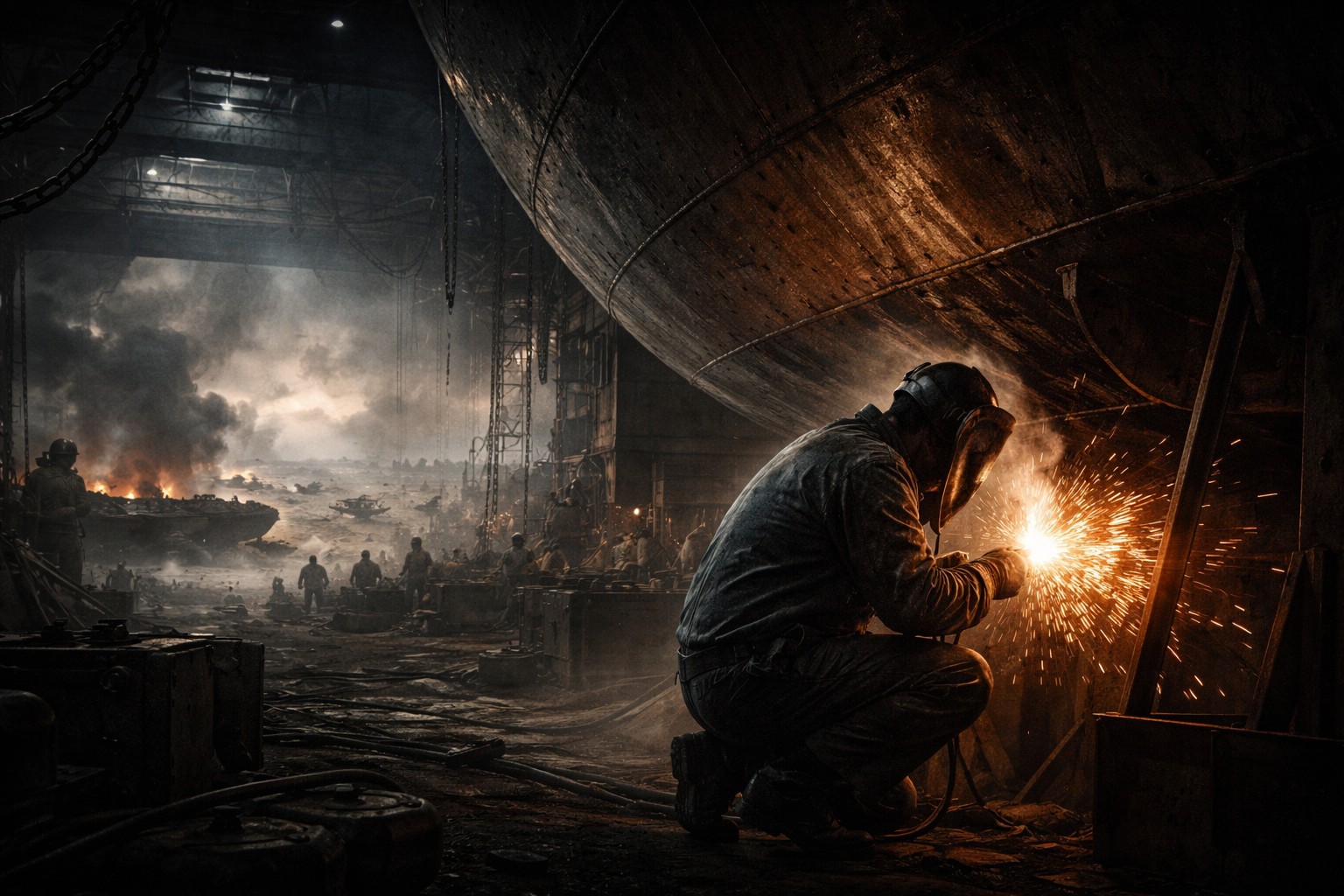
Courage was also present in places that heard no artillery fire. It lived in the shipyards of Richmond, California, the tank arsenals outside Detroit, in the foundries of Pittsburgh and the munitions plants scattered across New England; wherever men and women clocked in before dawn and stayed until long after dark, running machinery pushed well past its limits in service of the same war being fought on those famous shores.
Their contribution was immense. Their sacrifice was real. And when the war ended, the nation largely forgot them.
The Story America Knows by Heart
Roosevelt called it the Arsenal of Democracy, and the name fit. What American industry accomplished during the war years stands as one of the most extraordinary feats of production in human history. The statistics are staggering, even now.
Over 300,000 aircraft. 100,000 tanks. 193,000 artillery pieces. Two million army trucks. 2,700 Liberty ships, rolling out of American yards at a pace that staggered the imagination; one launched every day, at the height of production. American industry provided two-thirds of all Allied military equipment used in the war.
The numbers are staggering even now, and they should be; they helped win the war.
But those celebrated numbers carry a cost that never made the history books.
We remember what America made. We rarely ask what it cost to make it. The same national urgency that produced the industrial miracle also created conditions where human injury became a secondary concern; a byproduct absorbed into the larger accounting of victory. The great engine of war demanded steel and aluminum. It also demanded the bodies of the people doing the work. Nobody acknowledged that part.
Those ledger entries were kept in a different kind of file.

When Factories Became Front Lines
The American factory floor was transformed during the war years. The product lines changed — automobiles became aircraft engines, washing machines became shell casings — but the fundamental change was in the atmosphere surrounding it. Output became the single overriding objective, and everything else was subordinated to it.
Millions of experienced workers had left their positions for military service, and their places were filled with new hands: women entering heavy industry for the first time, retired men called back to the floor, workers who had traveled north and west chasing wartime wages.
Many of them were placed on complex, heavy machinery after training that lasted hours, maybe days, rather than months. There simply was not time for more.
The machines themselves were under similar strain. Equipment designed for an eight-hour day now ran without stopping. Maintenance was deferred because taking a machine offline meant slowing production, delaying a shipment. Gears stripped. Circuits overheated. Safety mechanisms, often viewed as impediments to production, were bypassed or ignored entirely.
These were not isolated failures at a handful of careless plants. They were systemic conditions, born from decisions made at the national level and felt on every factory floor in the country. Every factor compounded the next: the exhausted worker, the overworked machine, the deferred inspection, the accelerated schedule.
The front line, in the public imagination, was on the other side of the ocean. For the men and women clocking in before sunrise, the factory floor — with its unguarded belts, blinding sparks, and multi-ton presses running at full capacity — had become its own theater of hazard.
Nobody was shooting at them. The danger was more mundane than that, and in some ways harder to identify. It was the accumulated weight of long hours, inadequate rest, and the indifference of heavy machinery to the person operating it.
The machine did not know there was a war on. It just ran until something gave way.

A Day That Didn’t Make the Papers
The scale of the home front’s human cost is almost impossible to hold in the mind as a single thing. Numbers that large tend to lose their meaning. The only way to understand what actually happened — day after day, plant after plant, across four years of war — is to bring it down to a single shift, a single man, a single moment that nobody wrote about.
His name is Leo.
He is a welder, fifty-two years old, working the midnight shift at one of the great Kaiser Shipyards in Richmond, California. He came back to the trade after years away from it because the yards were hiring and the country desperately needed ships.
His task tonight is to finish the lower seams on a destroyer escort hull already several days behind schedule. That fact is not lost on him or anyone else on the floor.
The shift begins like any other. The building is enormous, a world of shadows and industrial smells; steel, gas, ozone, cutting oil. Leo eats a dry sandwich and drinks his coffee before pulling on his heavy gloves and settling up beneath the hull, glare shield down. He is tired. He worked four extra hours the night before, pushing a boiler housing through to inspection.
Around him, a hundred welding arcs crackle and grinders shriek without pause. He is in a tight, awkward space, and he needs to contort his body to reach the seam, feeding the wire slowly, keeping the arc steady beneath a section of scaffolding that was not as thoroughly secured as it should have been before the shift began.
He is focused on the weld. That is his job, and he is good at it.
He shifts his weight. The kind of small movement a man makes a thousand times in a long shift without thinking. A chain supporting the scaffold above him slips. There is no catastrophic sound; just a sudden impact, and then Leo’s arc goes dark.
The foreman noticed from sixty feet away, over the noise of everything else still running, because that one arc had stopped.
A medic was called. The shift manager came down and wanted to know how quickly the area could be cleared. Within forty minutes, the platform and scaffolding was stabilized and the teams working nearby had gone back to their tasks.
Leo’s name did not appear in the next morning’s paper. What happened to him was recorded somewhere in the company’s internal files; a work stoppage, another accident on a shift that still had hours left to run. The hull needed finishing. The yard moved on.
Leo’s story is real; a name drawn from the accumulation of documented cases, standing in for the thousands of men and women for whom no thorough individual record survives. His story happened every day.

The Numbers That Were Never News
Historian Andrew Kersten, in his study of American labor during the war years, reached a conclusion that sounds ridiculous until you look at the data: defense industry work could be more dangerous than serving on the front lines.
The Bureau of Labor Statistics backed him up. Between 1942 and 1945, it recorded more than two million disabling industrial injuries every single year. Two million. Per year. For four years.
At the Kaiser Shipyards in Richmond, California, the same yards where Leo worked his midnight shift, first aid stations and local hospitals documented 13,261 fractures alone. Hands, feet, ribs, and worse. One woman fell sixty feet from the top deck of a hull and fractured her skull.
Welders were regularly exposed to vaporized copper and zinc. The medical records tracked the injuries carefully enough to count them. What they couldn’t account for was what happened to those people after the war ended and the records were filed away.
The collective total of those individual disappearances is staggering; and deliberately difficult to pin down, which is itself part of the story.
Exact figures remain elusive for straightforward reasons. Home front fatalities were classified as industrial accidents. They were spread across thousands of plants in forty-eight states, recorded on local forms in varying formats. Nobody was compiling them into a national count. There was no strategic reason to.
What the available figures do show is shocking. During the four years of American involvement in the war, the nation suffered far more disabling injuries on the home front than it did military casualties on the battlefields.
The official statistics for disabling industrial injuries climbed into the millions; a number that, by a significant margin, exceeded the combined total of American soldiers, sailors, and airmen killed, wounded, or missing in action.
The lathe and the stamping press were statistically more likely to produce a long-term American casualty than the enemy’s rifle or artillery shell.
Had those casualties occurred in a single engagement, we would know its name. We would teach it in schools. Because they were spread out — one welder here, one foundry worker there, a machinist in a plant that no longer exists — the collective impact was fragmented into pieces small enough to ignore.
One at a time, they were manageable. Together, they tell a different story about what the war actually cost.

The Unspoken Bargain
The atmosphere on the American home front carried a moral impact that didn’t need to be spoken out loud to be felt. Every delay, every missed shift, every complaint about conditions carried an implication that went beyond the factory floor. The men overseas were dying. Showing up was the least a person could do.
Workers were well aware that the hours were brutal. They knew the risk was real. But the war had reframed that risk into something that couldn’t be argued with. The soldiers weren’t asking for better conditions. The sailors weren’t demanding shorter hours. Raising your hand to complain about a safety issue was an invitation to a comparison nobody wanted to invite.
So they didn’t. They absorbed dangerous conditions without raising them, pushed through exhaustion without reporting it, and when accidents happened, many tried to hide minor injuries rather than leave the line. A bandaged hand that kept working was better than a stoppage that delayed production. That calculation happened privately, countless thousands of times a day, in plants across the country.
Nobody had to spell it out. It was understood by everyone. The mission was larger than any one person, and the individual was expected to act accordingly. They did. That was the bargain, and they honored it without being asked twice.

When Safety Became Someone Else’s Problem
The federal government and private industry were not blind to the rising toll. They knew the numbers were bad, and they responded; just not in the way a worker with a mangled hand might have hoped.
Rather than address the conditions driving the accidents, the government partnered with corporations to launch safety campaigns aimed at the workers themselves. The resulting strategy was to convince people that accidents were the result of individual carelessness rather than systemic hazard. By doing this, the responsibility shifted away from the plant or conditions, and onto the person operating the machine.
General Motors led the way with a character called “Otto Nobetter,” deployed across small defense plants in Chicago to illustrate the consequences of worker stupidity.
Other campaigns produced characters named “Axidunce” and “Egghead” for the same purpose. The message was consistent; accidents happened to fools, not to untrained people working double shifts on machinery that hadn’t been serviced in months.
The campaigns targeting women were something else entirely. Posters depicted female workers as vain and distracted, more interested in jewelry and high heels than in doing the job properly.
Safety violations were illustrated with arrows pointing at a woman’s belted waist or loose hair, the implication being that women needed to be reminded of the obvious. That these same women were performing skilled industrial work, often for the first time, under conditions that veteran male workers found grueling, was beside the point.
The most revealing posters, though, were the ones that connected workplace injury directly to battlefield death. “Don’t Get Hurt — It May Cost His Life” ran alongside an image of a dead soldier.

“Idle Hands Work for Hitler” made the implication explicit: an injured worker wasn’t a victim of unsafe conditions, they were a liability to the war effort, possibly something closer to a collaborator.
Getting hurt on the job was reframed not as a consequence of overworked machinery and inadequate training, but as a personal failure with moral stakes.
The injured worker, in other words, had no one to blame but themselves. The company had the poster to prove it.
One government poster was more revealing than its creators likely intended. It stated plainly that more American workers had been killed and wounded in industrial accidents the previous year than all the casualties from German bombing raids on Britain over two full years of war.
The government printed that on a poster. They knew exactly what was happening inside the plants. The response was not better training, better equipment, or better enforcement of safety standards. It was more posters.

Injured, Not Honored
The biggest difference between military sacrifice and industrial sacrifice wasn’t in the dying. It was in what came after.
When a soldier was wounded or killed, a system of recognition existed to meet that moment; imperfect, often inadequate, but real. A Purple Heart. A pension. A letter from a commanding officer. Government insurance payouts. A flag handed to a family with the formal language of military honors. The loss was acknowledged by the nation as something that mattered.
When a worker was killed or permanently disabled on the production line, the response was fast and then over. Workman’s Compensation existed, but the payments were rarely proportionate to what heavy industrial machinery could do to a human body.
An amputated limb might mean a modest settlement. Severe burns might mean a weekly check that didn’t cover the bills. It always meant the end of a career and the beginning of a long, grinding financial decline.
There were no medals. There was no shared language of sacrifice and honor attached to what had happened. The company closed its record. The family carried on, often in silence, with the knowledge that their loss had been classified as a workplace accident and nothing more.
When an industrial death faded from local memory, it was gone completely. No monument commemorated the name. No annual observance kept the story alive. Without those things, there was nothing to hold onto, and the stories let go.
The war’s end brought no relief. If anything, it made things worse.
Sixteen million returning veterans came home to the GI Bill; housing loans, college tuition, unemployment benefits, vocational rehabilitation. The country had built an entire apparatus to ease them back into civilian life, and rightly so.
The industrial worker who had lost a hand in a press or a lung to chemical exposure came home to nothing comparable. Workers’ compensation claims, already modest, were routinely contested by employers looking to limit their liability. Companies had every financial incentive to deny responsibility, and they did.
Then the veterans came back and needed their jobs. Plants that had spent four years telling their workforce that every hour on the line was a patriotic duty now quietly began replacing injured and disabled workers with returning servicemen. Employers were reluctant to retain workers with existing disabilities; not out of cruelty necessarily, but because compensation law made them a financial risk.
The people who had kept the machinery running while the soldiers were gone found themselves expendable the moment those soldiers returned.
They had been essential and then, almost overnight, they were a liability. The country had needed everything they had to give, had taken it, and had moved on. The men coming off the troop ships got parades. The man or woman who had spent three years welding destroyer hulls and lost two fingers doing it got a bill they couldn’t pay and a job they no longer had.

Courage Without Uniforms
Wartime valor, as history tends to tell it, likes to live in a single moment; a charge, a last stand, a split-second decision under fire. That courage is real and deserves every honor it has ever received.
But there is another kind that is harder to see.
What does it take to walk into a known danger not once, in a defining moment, but six days a week, month after month, knowing the risk compounds with every exhausted hour and every machine running past its limits? The threat wasn’t a human enemy that could be outmaneuvered. It was mechanical and indifferent and it did not negotiate.
The workers of the Arsenal of Democracy faced that threat with a commitment that history has largely ignored. They understood, at some level, that if the machine took them, the loss would be logged as an accident. Their name would not be read at a ceremony. Their family would receive paperwork.
They went in anyway, because the work had to be done and they were the ones to do it.
That is a different courage than the soldier’s; sustained rather than sudden, anonymous rather than celebrated, built from the daily decision to return to a place that had already proven it could hurt you. It doesn’t compete with the sacrifice of the men in uniform. It simply belongs in the same conversation.

Why These Stories Slipped Away
When the war ended, the country turned to look forward fast. The relief was enormous, the need to celebrate overwhelming, and the desire to leave the weight of those years behind was entirely understandable and human. The returning hero. The defeated enemy. The economic boom stretching out ahead. These were the stories that healed, and my goodness did the country need healing.
The casualties of the production lines complicated that picture. To dwell on the tens of thousands killed in American plants — or the millions who came home from their own factories missing fingers, hands, their hearing, their health — was to admit that victory had carried another internal price that didn’t fit the celebration. Nobody suppressed these stories in any organized way. They were simply left untended, and they wilted.
Memory faded, as it tends to do. The clear lines of achievement held their shape. The harder details of what it cost to achieve them didn’t. The injured worker’s story had nothing to keep it visible; no monument, no observance, no official declaration that what happened to them amounted to service. Without those fixtures, the stories floated away, and a country already moving on at full speed left them behind.
Sacrifice in the Second World War was necessary. The achievement of American industrial production remains one of the most remarkable efforts in the history of organized human endeavor. Nothing here argues otherwise. Quite the opposite.
But the full story has never quite been told.
Wishengrad’s words have sat at the top of this page from the beginning, and it’s time to visit them here at the end. The workers who built the tanks and welded the ships understood that bargain without anyone spelling it out for them.
They went to work in buildings their neighbors drove past every morning without a second thought, doing jobs that could kill them, knowing that if the job did kill them, the country would move on before the day was out.
They showed up anyway. Because the war required it, and they were Americans, and that was what Americans did.
Most of their names are gone now. The records that might have preserved them were never carefully kept to begin with, and whatever remained has long since been done away with. That loss is permanent.
What is not permanent is the choice to acknowledge that these people existed, that their sacrifice was genuine, and that the victory they helped build was bought at a price the country never fully added up.
The soldiers and sailors who fought overseas earned every honor they received. The men and women who fed the war machine from the inside simply never got theirs.
They were part of the same story. It’s past time we told it that way.




Leave a Reply