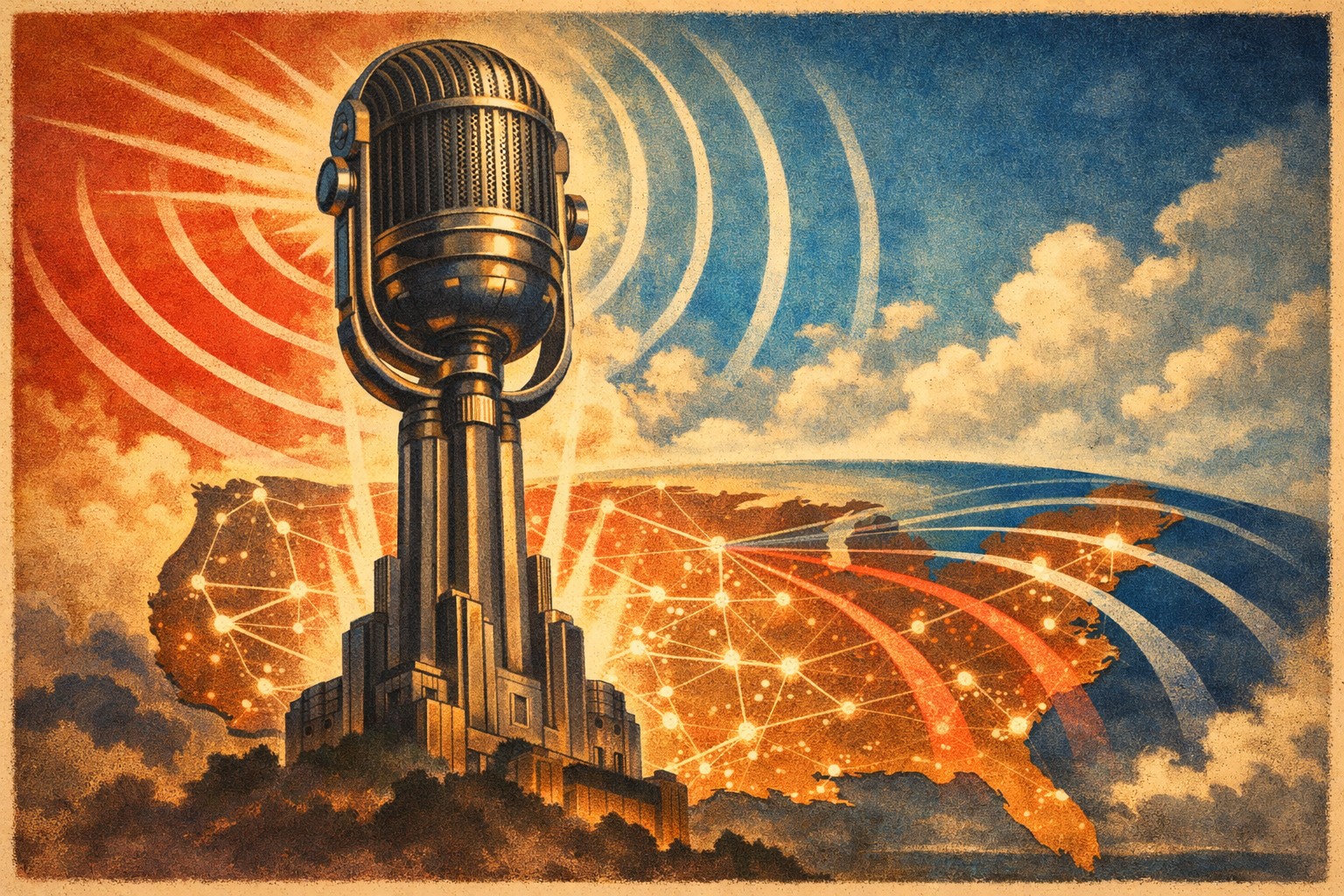
There was a time in America when the evening entertainment schedule required exactly one piece of furniture: a radio in the living room.
One of the things I enjoy most about writing in this little corner of the historical world is when I encounter fellow history buffs who tend to wander around the same territory. Every once in a while, one of us writes the exact article the other had been planning.
That happened today.
On Friday here at In the Shadow of Yesterday, we looked at the fascinating story of the Armed Forces Radio Service and its surprising influence on broadcasting. The idea for that piece was prompted by our friends at Commonplace Fun Facts.
While working on that piece, I found myself thinking about a related topic I’ve long wanted to explore: the strange early days of network radio, when a single company seemed determined to build a broadcasting empire large enough to wrap itself around the entire country.
As it turns out, our friends at Commonplace Fun Facts just published a terrific article on that very subject; specifically the story of NBC’s color-coded networks, the famous Red and Blue services, and the antitrust case that ultimately forced the company to spin off what would eventually become ABC (the “Lifesavers Network”; you read that right – go find out why).
Because there’s no sense rewriting something that’s already been done well, I’m happy to pass this one along. If you enjoy the history of broadcasting—and the odd twists that shaped the media landscape Americans lived with for decades—you’ll enjoy this story.
And if you’re curious about how one of those networks later connected to the wartime world of radio, you might also enjoy our recent look at the Armed Forces Radio Service, which carried American broadcasting across the globe during World War II.
Enjoy the article below from our friends at Commonplace Fun Facts.




Leave a Reply