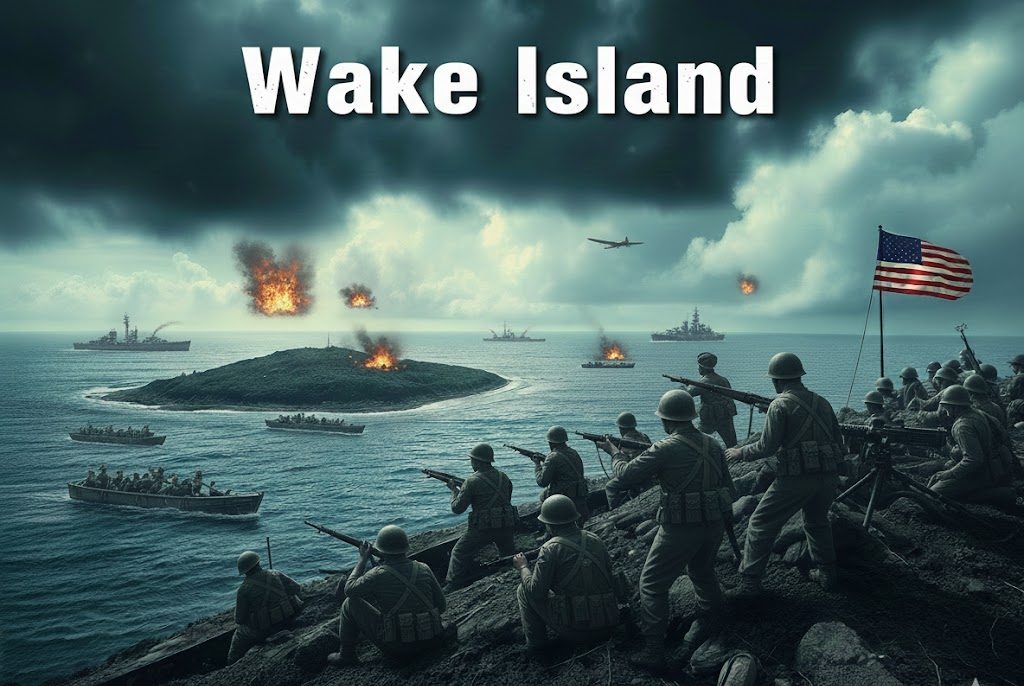
Following the catastrophic early morning attack on Pearl Harbor, Americans were in for even more bad news. They would soon learn that the Hawaiian attack was far from an isolated incident. On December 8th, 1941, Japanese forces immediately began executing their wider Pacific campaign. Hours after the attack that dragged America into the global conflict, attention shifted 2,000 miles to the west, where the guns of Imperial Japan were trained on Wake Island, a small, remote American outpost.
The defense of this minuscule atoll—barely 3 square miles of land—was under the overall command of Navy Commander Winfield Scott Cunningham. The ground defense was led by Major James P.S. Devereux of the U.S. Marine Corps, commander of the 1st Defense Battalion. His command consisted of fewer than 500 Marines and Navy personnel, supported by over a thousand civilian construction workers.
They faced a determined, highly-trained enemy force that was set on the swift conquest of the Pacific. Against an overwhelming tide of warships and aircraft, Devereux and his men mounted a desperate and bloody resistance that lasted for 15 days, forging one of the most celebrated and heroic stories of the early Pacific War.

Leaders Forged in Military Tradition
Commander Winfield Scott Cunningham was the officially appointed island commander, a career U.S. Navy officer and a highly experienced Naval Aviator. Born in 1900, Cunningham was a member of the U.S. Naval Academy Class of 1920 (graduating in 1919) and earned his pilot designation in 1925. His professional focus was on naval aviation and strategy, with tours aboard aircraft carriers and surface ships. His background made him a logical choice to command the Naval Air Station being constructed on Wake.
He arrived at the atoll just a week and a half before the attack, on November 28, 1941. His responsibility encompassed all assets on the atoll, including the Navy patrol squadron personnel, the civilian contractors, and the Marine defense units. As the officer in charge of the entire installation, the ultimate decisions for defense rested with him.
Joining Cunningham during this crisis was a tough Marine officer. The man responsible for the ground units under Cunningham’s command was Major James Patrick Sinnott Devereux. Devereux’s career had a surprising start for a man now in the middle of the Pacific Ocean.
Born in 1903 in Cabana, Cuba—where his father, a naval surgeon, was stationed—Devereux was naturalized as an American citizen and inherited a legacy of service. However, his path to becoming an officer was not the typical, prestigious route through the Naval Academy.
Instead, Devereux proved his mettle the hard way. He started his military journey by enlisting as a private in the Marine Corps in 1923. His later earned a commission in 1925.
The years between the great wars were far from quiet for Devereux. They were spent actively learning the trade of a Marine, with early tours in the world’s hot spots, including the Philippines and service with the First Marine Brigade in Haiti. This hands-on experience, forged in the field rather than the classroom, prepared him for the pivotal, bloody challenge he would face years later at Wake Island.
These postings offered valuable, firsthand experience in leading small units, managing logistics in isolated environments, and confronting irregular forces—challenges that demanded quick thinking and adaptability. By the time global conflict erupted in 1939, Devereux had cultivated a formidable reputation. He was known for his meticulous approach to tactical planning and an uncompromising dedication to his duty. These attributes made him a natural choice for the demanding command he would soon assume: the defense of a key, vulnerable, advance base in the central Pacific.

Wake Island: The Strategic Speck
To understand the uniqueness of the battle, one must appreciate Wake Island’s strategic geography. It was more than a speck of coral; it represented an important waypoint in the American defense network. Positioned almost exactly halfway between Hawaii and the Philippines, the triangular-shaped atoll served as a vital refueling stop for both ships and planes, and as an important communications and meteorological center.
When Japan’s military planners designed their plan for a rapid takeover of the Western Pacific, Wake Island was a primary objective. Its neutralization was essential to sever the American supply line, isolate the Philippines, and establish an insurmountable outer perimeter of defense for the Empire.
Despite its obvious importance, the island’s defenses were a work in progress in December 1941. Construction on airstrips and defensive fortifications was still underway, overseen by a large contingent of civilian contractors from the Contractors Pacific Naval Air Bases (CPNAB), primarily employed by the firm Morrison-Knudsen.
The military garrison—designated the 1st Defense Battalion—was pitifully small, consisting of just 449 Marines and sailors. They were tasked with operating coastal artillery, anti-aircraft guns, and a newly constructed airfield.
The island’s air component, Marine Fighting Squadron 211 (VMF-211), was equipped with only 12 relatively new Grumman F4F-3 Wildcat fighters, flown by 13 pilots. They faced an enemy force that would soon deploy warships and waves of modern, highly capable aircraft. Devereux’s greatest asset, however, would not be his machinery, but the fighting spirit he instilled in his men. He would demonstrate that even limited resources, when commanded with skill and courage, could inflict staggering damage on a superior foe.
First Day of the War
The news of the Pearl Harbor disaster reached Wake Island on the morning of December 8 (due to the International Date Line, the attack occurred simultaneously on December 7 in Hawaii). The island’s defenders were placed on immediate alert, though their ability to respond was soon put to the ultimate test.
At 11:58 a.m., an hour and a half after the alert, the first wave of Japanese bombers—36 Mitsubishi G3M “Nell” medium bombers launched from the Marshall Islands—struck the island. The attack was devastatingly effective. The initial target was the newly constructed airfield and the precious few aircraft parked there.
The U.S. Marines’ early warning radar system was still incomplete, meaning the aircraft were not detected until they were nearly overhead. VMF-211, caught largely on the ground during a refueling period, was annihilated. Eight of the 12 Wildcats were destroyed in the first bombing run, along with the hangar, communications gear, and medical facilities. Forty-nine servicemen and civilians were killed in the first few minutes of the battle.
Devereux, displaying coolness under fire, recognized that the battle was about survival and maintaining organized resistance. His immediate efforts focused on salvaging what could be saved from the damaged aircraft and equipment. He simultaneously worked to spread out the remaining coastal and anti-aircraft weapons to make them less vulnerable to massed attack.
Perhaps most importantly, he established secure communications and ensured all personnel, including the large civilian workforce, knew their defensive positions and orders. The surviving four Wildcat fighters, though hopelessly outnumbered in facing Japanese Zero aircraft that would soon arrive, were the only air cover remaining. Their pilots, however, were about to write their names into Marine Corps legend.

Air Combat: A Handful of Heroes
For the next four days, the Japanese assaults were exclusively conducted by air. The bombing raids were relentless, focused on systematically destroying the island’s defensive capability. But the four remaining Wildcats, flying from their damaged strip, performed miracles. The leader of the air contingent, Major Paul A. Putnam, coordinated a defense strategy that maximized the impact of his tiny force. They flew daring intercept missions, taking on enemy formations many times their size.

On December 11, the most critical day of the air battle, Marine pilot Captain Henry T. Elrod distinguished himself. He and the remaining pilots were engaged in continuous skirmishes. Elrod, a Medal of Honor recipient-to-be, not only shot down multiple bombers during the intense period of air fighting but also contributed significantly to the successful repulsion of the first Japanese landing attempt. The actions of Elrod and his fellow pilots did more than just shoot down planes; they provided a vital counter-punch that kept the defenders’ spirits up.
The constant aerial attacks took a toll on the remaining planes. By December 12, after a desperate reconnaissance mission, Major Putnam’s air force was reduced to one remaining Wildcat. This last aircraft was shot down on December 22, its pilot, Captain Frank Tharin, having successfully parachuted to safety. For the rest of the battle, the defense of Wake Island was solely fought from the ground.

First Assault Repulsed: December 11, 1941
The true measure of Devereux’s organization and his men’s fighting mettle came on December 11, when the Japanese mounted their first seaborn invasion attempt. The invasion force, led by Rear Admiral Sadamichi Kajioka, consisted of three light cruisers, six destroyers, and two troop transports carrying over 450 special naval landing troops.
This was to be a textbook amphibious assault, designed to quickly overwhelm the small garrison. The Japanese ships approached the island intending to provide overwhelming fire support as the landing craft hit the beaches. Devereux had anticipated a landing and had his coastal defense batteries prepared. Unlike the aircraft, the large caliber guns of the Marine 5-inch coastal defense battery were well-hidden and still operational. As the Japanese fleet closed to firing range, Major Devereux gave the order to fire. What followed was a stunning and completely unexpected reversal.
The Marine batteries, commanded by Captain Henry D. “Trigger” Platt, opened fire on the unsuspecting Japanese fleet. The destroyer Hayate, caught completely off guard, was hit by a salvo of 5-inch shells. It exploded violently and sank in less than two minutes, becoming the first major Japanese warship sunk by U.S. forces in World War II. Another destroyer, the Yunanari, was hit repeatedly by Marine fire, sustaining severe damage and being forced to withdraw from the engagement. A third, the Kisagari, was also sunk, this time by the dedicated pilots of the Wake Island defenders.
The combination of the accurate coastal fire and the aggressive, unexpected counter-attack by the remaining Wildcat fighters disrupted the Japanese landing plan. Admiral Kajioka, having lost one destroyer and seeing others damaged, made the unexpected decision to withdraw his entire invasion fleet. This was a humiliating tactical defeat for the Imperial Japanese Navy, marking the first time in World War II that a Japanese amphibious landing had been successfully repulsed.
The Marines on Wake Island had bought themselves a few more days, and the news of this small but significant victory became a much-needed morale boost back in the United States. They had inflicted damage and forced a retreat against a superior naval force—a credit to Devereux’s leadership and the quality of his men.

Holding the Line
The Japanese response to the repulse was predictable: they would not make the same mistake twice. Over the next ten days, the intensity of the air raids increased exponentially. The Japanese brought in more powerful, longer-range aircraft, systematically bombarding the island and eliminating what little remained of the island’s infrastructure, communications, and defenses.
Major Devereux and his men faced conditions that deteriorated hourly. The prospect of reinforcement or relief was nonexistent, as the U.S. Pacific Fleet, reeling from Pearl Harbor, had no capacity to launch a large rescue mission thousands of miles away. A relief convoy, Task Force 14, commanded by Admiral Frank Jack Fletcher, was dispatched, but was later recalled after the second Japanese invasion force was spotted, due to fears of losing further valuable capital ships.
The constant bombardment meant little rest and constant danger. Food and water were rationed, and the medical facilities were virtually nonexistent. The island was a continuous target, making for a continuously dangerous existence.
Devereux’s role during this phase was pivotal. He maintained a visible presence across the three small islets of the atoll—Peale, Wilkes, and Wake—ensuring that the defense remained unified. He wasn’t merely issuing orders; he was moving between positions and ensuring his officers were commanding their sectors effectively.
His steady calm was infectious, preventing demoralization and panic from crippling the fighting spirit. The Marines continued to fight. They salvaged machine guns from wrecked aircraft, created improvised defensive positions, and used their diminishing ammunition wisely. They held the line not in expectation of victory, but out of a fierce determination to make the enemy pay for every inch of the island.

A Painful Decision
The second Japanese invasion force was massive, leaving no room for error. The new force, commanded by Rear Admiral Shigematsu Sakaibara, included two heavy cruisers, six destroyers, and two troop transports carrying over 1,500 Special Naval Landing Force troops—more than three times the number of Marine defenders.
The assault began at 2:30 a.m. on December 23, 1941. This time, the Japanese employed a cunning strategy: they intentionally ran two troop transports aground on the south shore of Wake Island to provide immediate, fixed fire support platforms for the landing troops. The fighting was brutal.
Japanese forces quickly overwhelmed the initial beach defenses. The defenders on Wilkes Island, separated from Devereux’s main command on Wake Island, fought ferociously in hand-to-hand combat. A Marine patrol on Wilkes, led by Gunnery Sergeant John L. Baldomero, successfully attacked and destroyed a machine-gun emplacement, but the sheer weight of numbers was too much.
As the fighting spread inland and the Japanese began securing positions on the airfield, Cunningham and Devereux realized the hopeless reality. Their men were being killed and wounded at an unsustainable rate. Compounding the situation, the enemy was firmly established, and the few American forces were fragmented and running out of ammunition. Furthermore, the hundreds of non-combatant civilian contractors were also in danger of being caught in the crossfire and massacred.
Facing the prospect of a complete annihilation, Commander Cunningham, after consultation with Major Devereux and their senior officers, and receiving the tacit approval of his superiors via the last remaining communications, made the most difficult choice of their careers: he ordered the surrender of the garrison. The fighting officially ceased on the afternoon of December 23, 1941, exactly 15 days after the attack began. Though the island fell, the battle had demonstrated that the American fighting man, when well-led, was far from defeated.
Captivity and Courage
Commander Cunningham, Major Devereux, and the surviving 449 Marines, sailors, and the majority of the civilian workers were taken as prisoners of war (POWs). They were immediately subjected to the harsh and tortuous conditions characteristic of Japanese prison camps. The period of captivity was marked by starvation, disease, and forced labor. Devereux’s leadership did not end on the day of the surrender; it simply changed form.
In the prison camps, he maintained his sense of duty, working to keep up the discipline of his men, often at great personal risk, in defiance of their captors. He ensured that the military structure, however informal, persisted. The Japanese high command, still smarting from the humiliation of the December 11 repulse and enraged by the tenacity of the defense, singled out many of the defenders for particularly harsh treatment.
Devereux survived and was eventually released in 1945 following the Japanese surrender. His commitment and leadership under the worst possible circumstances cemented his reputation among the Marines who served under him.
Recognition and a New Calling
Upon their return to the United States, Commander Cunningham and Major Devereux were welcomed as national heroes. Thanks to them and their men, the country, starved for good news in the dark early days of the war, had latched onto the “Remember Wake Island” narrative as a symbol of American grit and perseverance.
Their distinguished service was formally recognized. Cunningham was promoted to Captain and remained in the Navy. He would return to sea duty and retire as a Rear Admiral. Further, both were awarded the Navy Cross, the second-highest military decoration for valor, for their “distinguished service in the line of his profession, extraordinary courage, and disregard of personal safety” during the defense.
After the war, Devereux continued his service in the Marine Corps, holding various administrative and command roles, retiring as a Brigadier General. However, in the late 1940s, he transitioned from a life in the military to one in politics. He was elected as a Republican to the U.S. House of Representatives from his home state of Maryland, where he served for five terms (1951–1959). His reputation for steadfastness and unwavering character followed him to Congress, where he remained a respected voice on military affairs.
A Heritage of Courage
The defense of Wake Island, despite being a loss in terms of territory, was a victory in terms of inspiration. It served as a powerful counter-narrative to the initial string of devastating Allied defeats in the Pacific. It proved that the American forces could, and would, fight with incredible valor against staggering odds. The phrase “Send us more Japs!”, widely attributed to one of the defenders in a radio message, captured the fighting spirit of the garrison and entered the American wartime lexicon.
The courageous stand against all odds by the men of Wake Island is permanently etched into the annals of the U.S. Marine Corps and military history. The performance of the officers on Wake Island was not only an example of military expertise, but of courageous and humane leaders who prioritized the safety and morale of their men even when facing annihilation.
The men of Wake Island turned a logistically doomed defense into a lasting example of tactical ingenuity and commitment to duty. Cunningham and Devereux didn’t just command a defense; they demonstrated that true leadership means standing with your men when the sky is falling. The 15 days of dedicated resistance on that small Pacific atoll show that moral fortitude, not simply material superiority, often determines the outcome of a battle—or at least, the lasting honor with which it is remembered.
The saga of Major Devereux and the Wake Island defenders didn’t end with the surrender; it immediately became part of America’s cultural story. In those dark early days of the war, the fighting men of Wake instantly became desperately needed symbols of American courage. The defense became a modern-day “Alamo”—a story of overwhelming odds met with unflinching courage.
The events were swiftly turned into wartime drama for the radio, aiming to rally the nation. To truly grasp how this story was received and remembered, we can look directly at two pieces of media from that time: the sobering, factual news report that first delivered the final, grim details of the island’s fall, and the powerful, dramatized Lux Radio Theater performance that cemented the garrison’s heroism in the public mind.



Leave a Reply